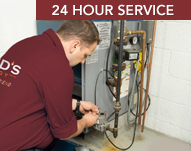
You’ve Got a Friend!


Looking for heating oil, propane, a new heating or cooling system, a plumber, a repair job, stylish kitchen fixtures, a full bathroom remodel, or that all-important 24-hour emergency service? Then you’ve come to the right place because at Fred’s Energy, you’ve got a friend! Your satisfaction is our number one priority and it’s a privilege to serve you. As a result, we take your needs very seriously. Our friendly, dedicated and experienced team is eager to help you get your project done efficiently and at a competitive price!
We’ve been proudly serving the heating, cooling, and plumbing needs of local communities since 1973. Our friendly, dependable and personalized service has helped us grow from a small shop with just two trucks, to four office locations with a staff of over 100 talented professionals and an extensive fleet of utility vehicles. We value and respect our customers and are constantly evolving and investing in our employees, as well as in our equipment, to offer you an even greater range of services. Our product line continually increases, as well, to offer innovative and convenient products to make your life easier for total, year-round comfort.

GO GREEN & SAVE SOME GREEN!
Spring is finally here, yet how do you deal with the fluctuating temperatures? Answer: an environmentally friendly and energy-efficient heat pump. It’s like an air conditioner that also provides heat. Powerful, yet quiet, and also space saving, a heat pump is the ideal choice for green living! Control the temperature in the individual rooms you want, not those left unoccupied. Great for room additions, too, where ductwork just isn’t practical. And now through July 31st, 2024, get $100 off a complete heat pump installation from Fred’s Energy. Enjoy a whole new level of comfort! Call your local Fred’s Energy office in Derby, Lyndonville or Morrisville today to learn more or for a free, no-obligation quote. (Please note: our Richford office only delivers fuel at this time.)

STILL REELING FROM HIGH HEATING BILLS?
Consider replacing your old heating system with a more efficient and reliable system that will pay for itself in fuel cost savings! Enjoy a whole new level of comfort! And now through July 31st, 2024, get $100 off a new heating system installation from Fred’s Energy. Enjoy a whole new level of comfort! Call your local Fred’s Energy office in Derby, Lyndonville or Morrisville today to learn more or for a free, no-obligation quote. (Please note: our Richford office only delivers fuel at this time.)

FURNACE/BOILER SPRING CLEANING OFFER
It’s spring and time to have your furnace or boiler professionally cleaned to remove debris from deep inside your system, check for corrosion, and eliminate soot and grime that could otherwise circulate throughout your home. Stay safe and keep your heating system reliable and running at peak efficiency. Schedule your professional spring cleaning by July 31st and get $20 off! Call your local Fred’s Energy office in Derby, Lyndonville or Morrisville today. (Please note: our Richford office only delivers fuel at this time.)

HEAT PUMP SPRING CLEANING OFFER
It pays to be proactive! Having your heat pump professionally cleaned annually can save you money on energy bills and potential repair costs. A mixture of moisture and dust builds up on the coil throughout the year, which can lead to the growth of mold during inactivity. Stay healthy, improve airflow, increase efficiency, and when you schedule your cleaning by July 31st, get $20 off! Call your local Fred’s Energy office in Derby, Lyndonville or Morrisville, VT today. (Our Richford office only delivers fuel at this time.)
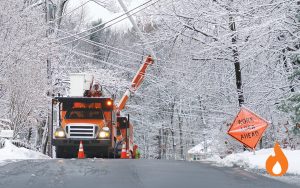
POWER OUT AGAIN???
How many times did you lose power this past winter? Tired of losing your heat? Even after the snow is gone, summer lightning storms with high winds and falling branches can also knock out your power for days. Be prepared with a whole house standby generator from Fred’s Energy!
• Heavy-duty commercial-grade engine stands up to extreme weather
• Automatically restores power to lights, water, appliances, heating source and security system, too – whether you’re home or away
• Runs on propane or natural gas, so there’s no refueling
• It’s quiet, too!
Call your local Fred’s Energy office today for a free, no-obligation quote or to schedule your spring install.
Trio Plus Air Purifier – for a healthier home!

Winter can be a challenging time with dust, pet dander, mold, dust mites, and other indoor allergens. We’re spending a lot more time inside with the windows closed tight. If you have allergies or suffer from asthma, or just want to breathe easy, breathe deep, and breathe healthy, consider a Trio Plus air purifier and filtration system from Fred’s Energy. This remarkable, state-of-the-art portable system removes indoor air pollutants such as smoke, dust, pollen, pet dander, and even toxic gases from household products and cleaners.
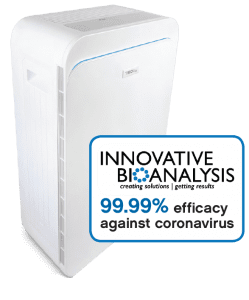
With true HEPA and carbon filtration, Pro Cell VOC reduction technology, and powerful UVC lamps, this exceptional air purifier also reduces mold, odors, and viruses with a 99.99% efficacy rate against coronavirus!
Call your local Fred’s Energy office today to learn more.